
This is the second SPS post on the subject of the ExxonMobil ‘Solent CO2 Pipeline Project.
The front page summary post, which is the best place to begin for the reader new to the subject, can be found by clicking this link.
Alternatively, the full list of SPS Posts on the subject can be found by clicking this link.
Following our previous article on the subject of the proposed ExxonMobil CO2 pipeline, we now dig deeper into the growing number of questions which need to be asked and consider which parties might be best placed to answer them.
We were pleased to see this report in ‘On the Wight’, which shares a copy of a letter written by the steering committee of the Isle of Wight Biosphere to the Solent CO2 pipeline project team. Click the underlined links to read the detail. The Isle of Wight Biosphere letter draws together many of the questions raised by this proposal.
The number of economic and environmental concerns raised is growing daily and the management team at Solent Protection Society believe that there are some rather more fundamental questions that also need to be asked:
- What is the real motivation behind this proposal?
- What is the funding model?
- By what criteria can this proposal be considered a ‘Nationally Significant Infrastructure Project’?
- Is the overarching governance approach impartial and independent?
- Will the decision process be open and transparent?
What is the real motivation behind this proposal?
The project is being heavily promoted by The Solent Cluster, the local alliance of businesses, academic establishments and local authorities that has emerged from the now-disbanded Solent Local Enterprise Partnership, best remembered for its flagship Solent Freeport project. With the Solent Freeport ambition now scaled right back, the primary focus of the new-look Solent Cluster looks to be ExxonMobil’s promise of Carbon Capture at the Fawley refinery works.
It’s worth pointing out that the well publicised shortage of CO2 for manufacturing purposes would suggest that ExxonMobil might more realistically be looking to capture the output from its Fawley facility and monetise it, rather than dump it.
What is the funding model?
Who will be paying for this? A good question. With the apparent scrapping of ambitions for several of the Solent Freeport tax sites, notably at Fawley Waterside, Navigator Quarter and Dunsbury Park, ExxonMobil, as a founding member of both Solent Local Enterprise Partnership and Solent Cluster, will be looking to maximise UK Government funding opportunities for the works at its Fawley site. It is reasonable to expect that ExxonMobil will be expecting the tax payer to cover a large slice of the funding.
By what criteria can this proposal be considered a ‘Nationally Significant Infrastructure Project’?
The declaration of Nationally Significant Infrastructure Project (NSIP) status to the ExxonMobil CO2 pipeline proposal enables the company to fast-track the assessment and decision process, bypassing local authority guidance and devaluing long-established environmental designations. Engagement with local landowners and the local communities through this current ‘consultation’ appears to be a ‘tick-box’ exercise to progress a milestone plan, rather than a serious attempt to solicit informed opinions and stimulate discussion of options. It is quite clear to the community that none of the three shortlisted route corridors are acceptable.
This development proposal does not appear to fit the published criteria for a Nationally Significant Infrastructure Project (NSIP) and SPS believes that a full and transparent review of that status by the Planning Inspectorate and the Department of Energy Security and Net Zero is essential before the currently published proposal can be progressed.
Is the overarching governance approach impartial and independent?
On 30 April 2024, the North Sea Transition Authority (NSTA) opened a competitive process inviting applications for Carbon Dioxide Appraisal and Storage Licences in an area in the English Channel. These licences grant exclusive rights for the exploration and appraisal of potential storage sites for carbon dioxide in the subsurface. Applicants had to note their interest in submitting an application within the first two weeks of the process, and had to submit applications by Wednesday 5 June 2024.
“These awards will allow us to leverage our unique CCS [Carbon Capture and Storage], subsurface and project management expertise to help the UK achieve its net-zero ambitions,” said Michael Foley, ExxonMobil’s UK Low Carbon Solutions business lead. “In addition to our activities in the Scottish and Solent Clusters, we’re proud to now be involved in these North Sea licences to help move offshore carbon storage from potential to reality.”
ExxonMobil – Newsroom
The North Sea Transition Authority is an executive non-departmental public body, a quango operating as a regulator, sponsored by the Department for Energy Security and Net Zero. It is the NSTA that will issue the licences for the laying of the undersea pipeline and the use of the English Channel storage site. Without those two components in place, the ExxonMobil Solent CO2 Pipeline project would not be viable and yet the company only has to ‘consult’ on the inshore and land-based components of its overall program of works.
No information of substance has been provided in the ExxonMobil CO2 Pipeline consultation documentation about the onward subsea route or methodology. This makes the consultation inadequate to judge alternatives.
Will the decision process be open and transparent?
Anyone with hands-on experience of global corporate business, especially those who have actively engaged in commercial and contractual relationships with national and local government authorities will know just how one-sided the contest can be. Government departments and local authorities rarely function at the same speed and level as commercial enterprises and with political reputations being gambled on climate solutions and the quest for ‘Net Zero’, the risk of the wrong decision being made is high.
The following important and topical article was recently published by Drilled, a global multimedia reporting project focused on climate accountability. Click the image below to read the article.
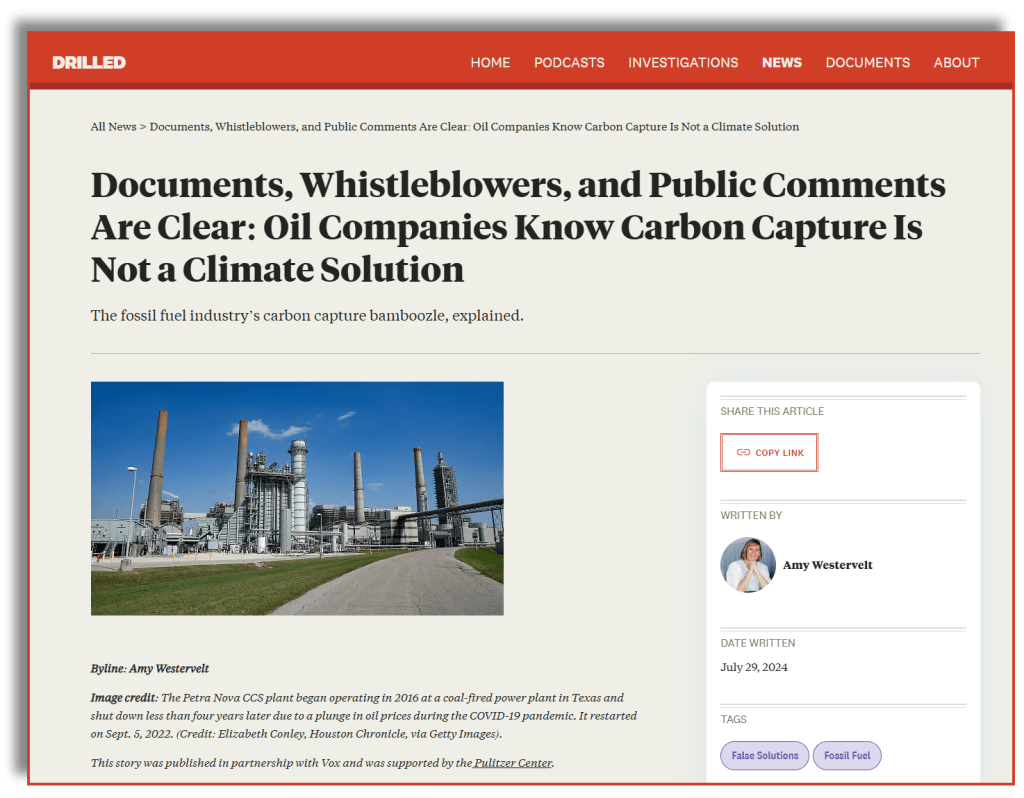
We at Solent Protection Society suggest that you write to your Member of Parliament and recommend they read it too.
It is they who are best placed to obtain the answers to these questions, starting with the Department for Energy Security and Net Zero.
Take this link to find your MP
This is the second SPS post on the subject of the ExxonMobil ‘Solent CO2 Pipeline Project.
The full list of SPS Posts on the subject can be found by clicking this link.
To read the next in the series, click here.
 Solent Protection Society