
Six years ago, the Solent Protection Society Council agreed on four main focus areas for which we should keep a watching brief; Pollution, Planning, Climate Change Adaptation and Marine Science. As we move into 2025, the set remain valid and while Southern Water continues to keep us occupied on Pollution and Planning, during 2024 the topics of Planning and Climate Change Adaptation have certainly stepped up a gear.
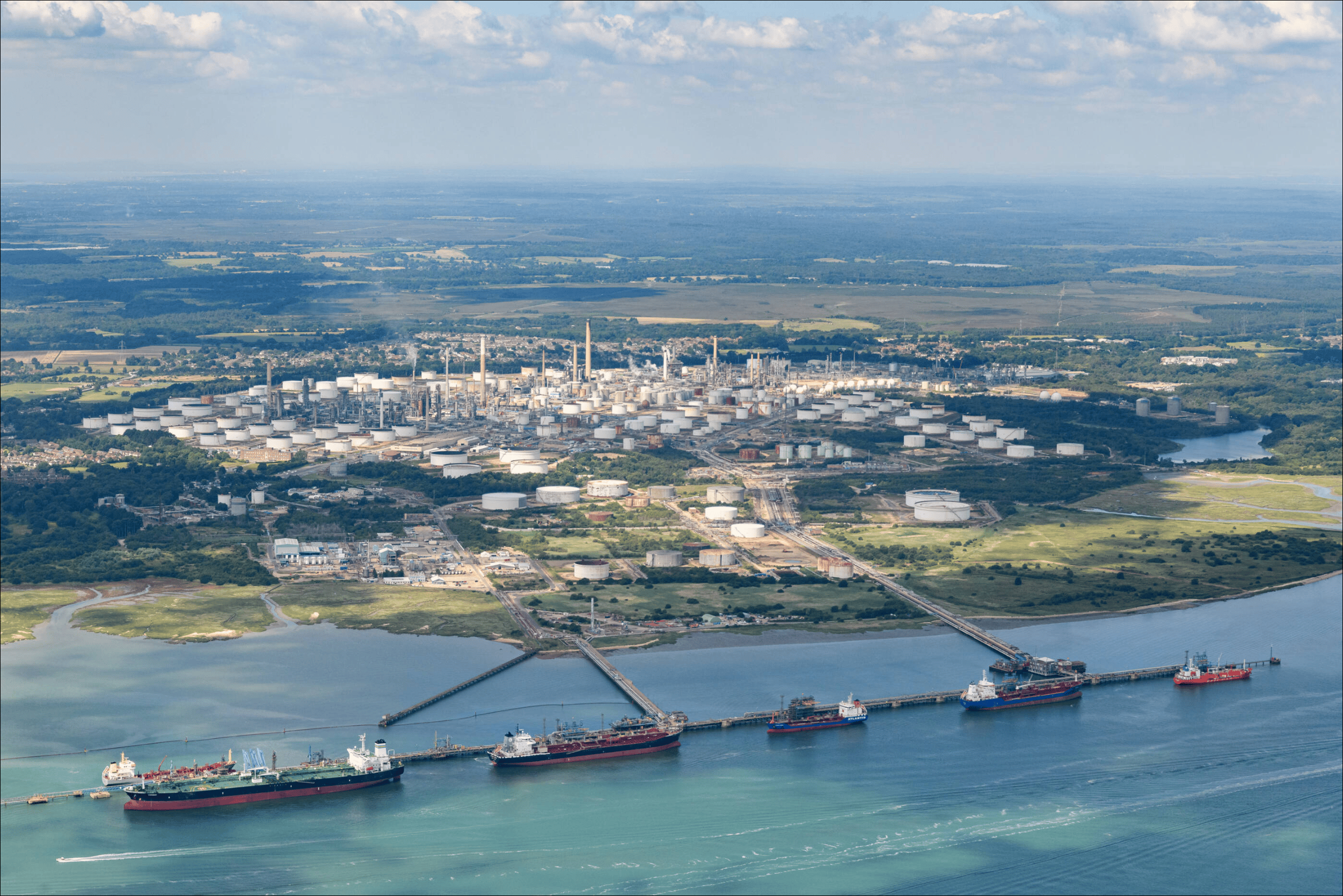
Take Climate Change Adaptation. Communities across the Western Solent and the Isle of Wight were thrown into disarray during the late summer 2024 holiday period by the publication of a proposal by ExxonMobil. The proposal was for an application for a Development Consent Order to construct a pipeline which would transport CO2, captured and liquefied by new processes at its Esso Fawley refinery, for permanent storage in a saline aquifer deep below the sea bed south west of the Isle of Wight.
The announcement forced local communities on both sides of the Solent onto a steep learning curve as they confronted the oil company’s apparently blatant disregard for the local environment, local businesses and the local population. Social media outlets burst into life and a campaign against the company’s proposal rapidly gained traction.
SPS took a deeper dive into the story through a series of website articles which opened up the possible deeper commercial and political drivers behind the proposal. The articles outlined the theoretical and practical aspects of the UK government’s industrial decarbonisation strategy and its net-zero carbon goals for the major industrial conurbations in the northeast and the northwest of the country.
As former centres of oil and gas exploration, with depleted undersea aquifers and existing clusters of heavy industrial emissions, the north of England and the Scottish proposals made a certain degree of sense. However, here in the south it was apparent that the sole significant source of carbon emissions was ExxonMobil itself, leading some to think that its rushed proposal had been little more than a delaying tactic to justify the extension of its carbon-intensive product line at Fawley for the foreseeable future.
As we looked into the commercial drivers, it became clear that the ‘Solent Cluster‘ of local industrial businesses was not only far smaller than its peer ‘industrial clusters’ in the north of England and Scotland, but that it was lagging a long way behind them in terms of competing for UK Government support. It became evident that the company’s efforts in lobbying central government from behind the relatively weak façade of the Solent Cluster would not yield the support ExxonMobil sought. Just three days after the consultation period ended, the Company cut its losses and the project was withdrawn.
As a spin-off, it seems unlikely that either the Solent Cluster, or its former Solent Local Enterprise Partnership stablemate, the Solent Freeport, are likely to live up to rash promises made in previous years so in 2025, we’ll be looking directly at the two big players on the Southampton Waterside front for indications of new plans for Southampton’s western waterside.
ABP are already rumoured to be planning a Development Consent Order application and we would not be surprised to see another, more considered initiative from ExxonMobil and it will be interesting to see the company’s next move. Well-known Thorns Beach homeowner, Jim Ratcliffe, has already made the decision with his Chinese partner in ‘PetroIneos’, to shut down traditional refinery operations at the UK’s only other refinery of Fawley’s scale and longevity at Grangemouth. This leaves ExxonMobil’s Esso Fawley site in an interesting position. Does ExxonMobil continue the refining of imported oil for a contracting UK market, or does it follow the PetroIneos model, exporting the decarbonisation issue by importing refined products from Kuwait and Rotterdam? A conundrum which pitches UK centric net zero ambitions against the wider global model.
Further south along the Fawley Waterside, the ever-fanciful plans for ‘Portmeirion-cum-Poundbury’ at the old Calshot power station site have finally been shelved in 2024, leading the site potentially open to a more realistic and sustainable employment and housing use. The Chair of the Solent Freeport was adamant that the site provided the biggest opportunity for freeport benefits during a recent meeting with SPS and the New Forest Association.
We will be watching with interest.

As this article ‘goes to press’, concern is spreading on the Isle of Wight about the anticipated loss of jobs at the Newport facility of the Danish company Vestas, bringing us back to our own prediction for the Freeport boundary during the early stages of the Solent Freeport bid. Perhaps we had the right idea when when we predicted that the Isle of Wight River Medina sites should have been included within the Freeport outer boundary? The Medina manufacturing sites might have proved rather more productive than the inclusion of Navigator Park, Eastleigh, and Dunsbury Park, Havant.
SPS expects to see action on the Southampton Waterside in 2025 so do keep an eye on the website for details as the year progresses. In the meantime, we wish our members and visiting readers the very best wishes for the festive season. Do feel free to join us in 2025.
Solent Protection Society is a small local charity managed by a Council of trustee volunteers.
Established 1956 Registered Charity 1154317
We would welcome your support