
As climate change progresses, rainfall patterns in the UK are expected to undergo significant changes. A summary of the key trends, as viewed by the UK Meteorological Office, shows that the UK is projected to become wetter, with an overall increase in annual rainfall. The frequency and intensity of heavy rainfall events are expected to rise, with more frequent and intense downpours leading to a higher risk of flooding; winters are likely to become wetter, while summers may become hotter and drier, resulting in more intense storms in both seasons.
It is worth noting that in the UK, less than 4% of annual rainfall is captured and stored for public water supply, a figure that might appear surprisingly low given our recent experience of torrential downpours and local flooding. We might therefore expect the UK water companies to be focusing on a portfolio of strategic options for future water supply which use capture and storage programs involving the construction of large general reservoirs, networks of smaller winter storage reservoirs and more comprehensive management of existing, new and previously-mothballed aquifer storage sites.
The consultation on Southern Water’s revised draft Water Resources Management Plan closed on 4 December 2024, for most of the company’s customers as quietly as it had begun. Southern Water has never taken the opportunity of using its regular billing communications to inform customers about upcoming plans, instead leaving its customers to learn the importance of these strategic consultations by word-of-mouth from other public sources.
The communication gap had been picked up by the Havant-based ‘Water Matters’ team, an association of local residents’ associations, environmental groups, individual residents, local authority elected representatives and one of our SPS Council team. Having spread the message to contacts across the Isle of Wight and West Sussex, there are hopes that DEFRA, as recipient of the consultation responses, will sit up and take notice of the detailed and well-informed content no doubt raised in many of these responses.
The Society’s response to Southern Water’s revised draft Water Resources Management Plan can be viewed by clicking the following image
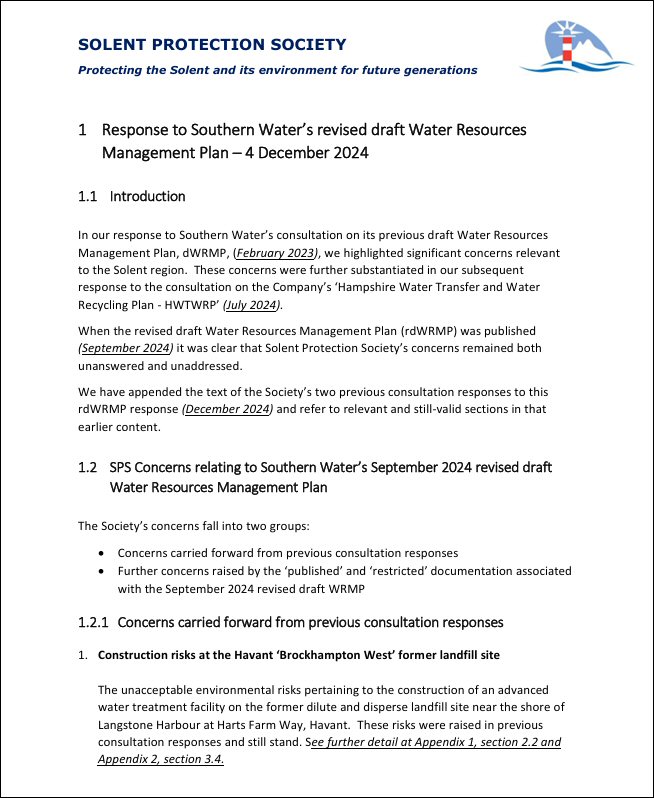
It should be noted that Southern Water’s rdWRMP consultation document library comprised 32 published documents and a further 12 documents restricted from public view for reasons of ‘commercial confidentiality’ or ‘national security’. The full list of documents, including a significant supporting spreadsheet only visible with the restricted documents set, is visible by clicking this link.
Having had sight of the restricted document set, the SPS Vice Chair believes that an accurate assessment of the rdWRMP cannot be made from the published documents alone, hence request in the Society’s response for DEFRA to sponsor a comprehensive and independent audit of the full document library.
Southern Water’s strategic option for future drinking water supply
Southern Water’s latest ‘revised draft Water Resources Management Plan – rdWRMP’ has deferred further analysis of the ‘nature-based’, environmentally sound, sustainable and cost-effective options outlined earlier, until a future revision of its WRMP in the hope that its latest strategic options will have been approved by the Secretaries of State and would be well into delivery by that point.
So what are Southern Water’s strategic options?
The primary strategic option for future water supply is the delivery of four advanced sewage effluent recycling plants built as extensions of the Company’s waste water treatment plants at Sandown IoW, Budds Farm in Havant, Littlehampton in West Sussex, and further afield at Horsham, also in West Sussex. A recent BBC South Today article entitled “Toilet to Tap” on the Sandown recycling plan in which Tim McMahon, Southern Water’s ‘Director of Water’, described the “Sewage Treatment Effluent Recycling”. You can view that BBC article, together with our ‘Fact check’ response, in a previous SPS article which you can read by clicking this link.
The secondary strategic option is frankly extraordinary, clearly intended simply to reinforce the argument for its primary option. Southern Water has drawn up contingency plans to import water from Norway by tankers to a Southampton port facility from where it would be pumped along a temporary pipeline beside the River Test to a local storage lake pending further treatment. The plan would see up to 45 million litres of water shipped to the UK per day. This water would, by virtue of its geological source, have a completely different chemistry to that of the River Test.
The Capital Expenditure (CapEx) trap
The UK water industry operates under a system where companies earn returns on their investments based on their regulated asset base. This incentivises large capital projects because the more capital a company invests in infrastructure, the larger the asset base on which they can earn regulated returns. For that reason, politicians and regulators often prefer high-profile infrastructure projects that can be seen as decisive actions to address water scarcity.
Southern Water’s preferred strategic option is outrageously expensive, with the proposed Havant Budds Farm effluent recycling plant and its linking infrastructure to the Otterbourne water treatment works alone, currently costed at £1.2bn – £1.4bn to build plus a further unpublished significant amount per year to run. By way of contrast, Portsmouth Water’s Havant Thicket Reservoir is currently costed at £350m to construct with relatively low on-going running costs, and a 200 year life expectation. (Solent Protection Society members will already have seen an article on the unfortunate connection between the two companies in our recent printed Newsletter.)
Unfortunately, Southern Water is no exception to the alarming and much publicised state of debt in which the UK privatised water companies find themselves, and since routine emergency and maintenance costs are handled separately, preventative maintenance is rarely prioritised.
Southern Water are not permitted to make a profit on routine or emergency maintenance activity and do not therefore prioritise preventative maintenance, so without profit, investors have little interest in such activity. It is, as the recent double pipe burst (Ryde and Old Portsmouth) shows, nevertheless essential. And that’s not all, the Company currently loses around 100 million litres of water every day to leaks, that’s 19% of the water they treat. Southern Water’s slow programme for improvements mean that even by 2050 they will still be losing about 10% of all the water they treat, and that’s including the “new water” manufactured at huge cost from their planned new effluent recycling schemes.
Since the source for the primary strategic option for ‘new water’ for the Solent area would be the treated sewage effluent from Budds Farm WWTW and Sandown WWTW, it is alarming to see the fragility of these sources highlighted so vividly in December 2024 by the ongoing bursts affecting main sewers supplying both sites.
See this separate SPS article for details.
Playing the Nationally Significant Infrastructure Project (NSIP) joker
Not content with just refusing to disclose essential information in the rdWRMP Consultation, it appears that Southern Water is also playing a Joker in its submissions to the UK Gov Planning Inspectorate.
Analysis of the currently available NSIP project register (December 2024) shows the project recorded under Application Type ‘WA01 – Dams and Reservoirs’. The project actually has two clear components, the first being a new advanced effluent treatment stage at Budds Farm WWTW, the second being a 40+km water transfer pipeline project to move output from the proposed recycling plant to the Otterbourne WTW. There are two very clearly defined NSIP Application Types which would more accurately define these sub-projects, ‘WW01 – Waste Water treatment works’ and ‘WA02 – Transfer of Water Resources’.
The only association that Southern Water’s HWTWR project has with a ‘dam’ or a ‘reservoir’ is in Southern Water’s desired change of use for Portsmouth Water’s already approved and under construction Havant Thicket Reservoir, to provide the essential environmental buffer component for its Budds Farm recycling proposal.
This proposed change of use is hotly disputed by local residents, environmental groups and Havant Borough Council whose planning services team approved the reservoir construction exclusively for the storage of raw water from the local Havant and Bedhampton chalk springs. Solent Protection Society shares these concerns, as we outlined in our response to the rdWRMP.
It looks very much to the Society that Southern Water is simply trying to ‘fast track’ its Hampshire project through the National Infrastructure Planning system by registering the two controversial components as an attractive ‘Dam’ or ‘Reservoir’ project, presumably in the hope of securing a fast path through the system.
Following our the Solent’s experience with ExxonMobil at Fawley earlier this year, Solent Protection Society will be directing our ‘Planning’ focus in 2025 to the use of the NSIP process to attempt to fast track planning and disempower public consultation. With the current UK government focus on fast-tracking housing projects and hitting net-zero targets, there is a danger that the Planning Inspectorate will simply become overloaded.
Further reading
If you would like to understand the detail behind the advanced treatment of sewage effluent, including the use of reverse osmosis filtering , we draw your attention to this detailed presentation by Dr. Marc Pidou of the Cranfield Water Institute, courtesy of the Havant Matters website which itself provides the most detailed independent source of information on Southern Water’s Water Resources Management Plan.
 Solent Protection Society