
This is the first SPS post on the subject of the ExxonMobil ‘Solent CO2 Pipeline Project.
The front page summary post, which is the best place to begin for the new reader, can be found by clicking this link.
Alternatively, the full list of SPS Posts on the subject can be found by clicking this link.
Contents
- The ExxonMobil Solent CO2 Pipeline Proposal
- What are the proposed ‘corridor’ options?
- Where can I find the detail?
- What are the timescales?
- How can I engage with this consultation?
- How can I respond to this consultation?
- The increasing use of Development Control Orders
The ExxonMobil Solent CO2 Pipeline Proposal
One of Solent Protection Society’s four prime areas of focus is ‘Climate Change Adaptation’ and this proposal from ExxonMobil relates to the use of a carbon capture and storage (CCS) approach to the removal and storage of excess carbon dioxide, CO2, from the company’s works at the Fawley Manufacturing Complex.
For readers new to the CCS approach to the mitigation of climate change, this Wikipedia article offers some helpful broad-based background reference material. The approach has been adopted by all of the major oil companies as a public demonstration of their commitment to climate change, a level of commitment disputed as ‘greenwashing’ in this report commissioned by Greenpeace.
The ExxonMobil Solent CO2 Pipeline Project is seeking approval to install an underground pipeline to transport captured CO2 from the Fawley complex to a ‘safe and secure storage location’ in the English Channel.
(N.B. The term ‘underground’ in the consultation documents is misleading. The only real underground pipe is a bored tunnel beneath the Solent from Lepe to Gurnard through which the pipe is pulled, possibly with a joint midway across which would require a temporary structure in the middle of the channel.)
Put simply, the project seeks to lay a 60cm diameter steel ‘underground’ pipeline from the Fawley site out to sea, by cutting a trench across one of three proposed land ‘corridors’, two across the Isle of Wight, the third between Fawley and New Milton. Along the selected corridor, ExxonMobil will be looking for approval to clear a 50 metres wide route of all topsoil to provide the working space in which to install a steel pipe just 60 centimetres in diameter.
The need to clear such a wide swathe of land in order to construct and lay the pipe is dictated by the proposed method of construction. Pipe sections would need to be brought in by road transport, off-loaded and welded into a continuous pipeline in-situ. Alongside this, heavy machinery will be digging a trench at least two metres deep into which the welded sections of pipeline will be lowered as a continuous process by a coordinated set of plant machinery. The illustration below shows a gas pipeline under construction in Gloucestershire in 2010 using this approach.
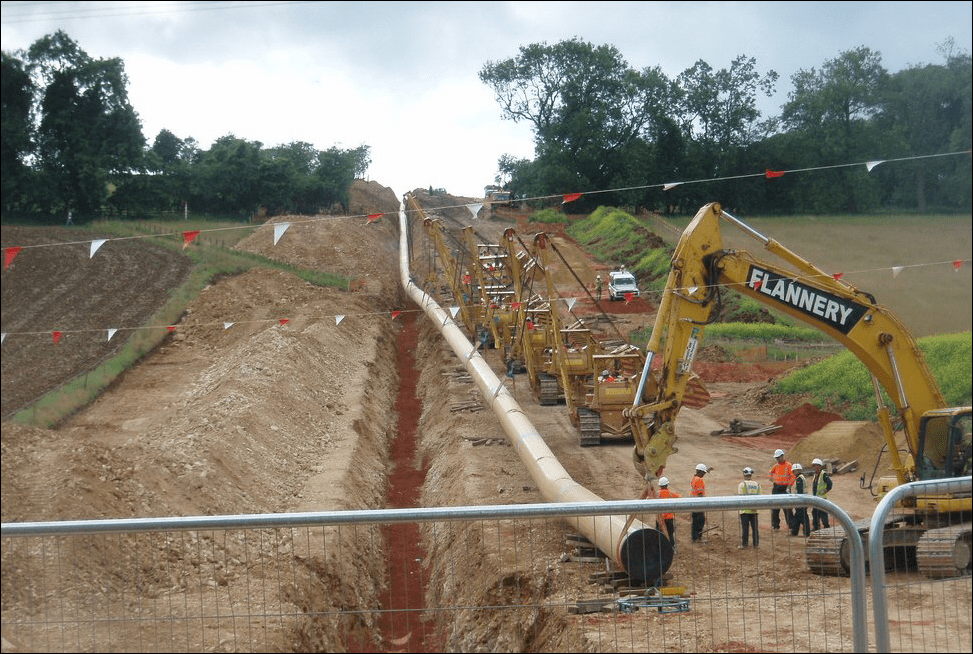
Over the course of such a development project, the volume of heavy machinery necessary to clear the land, bring in the pipe sections, dig the trench, weld and lower the pipeline and backfill the trench, would be significant. Regardless of which land corridor is chosen, the local roads would be unable to handle it so, in effect, what ExxonMobil is seeking is approval to acquire, clear and construct a temporary eight lane highway along the selected route.
When the construction of the pipeline is complete, the machinery would be removed and the land reinstated, leaving a 25 metre wide easement to enable future maintenance. (If you’re unclear what an easement is, then this blog post on ‘wayleaves’ provides useful background reading.)
Once beneath the open English Channel and away from coastal waters, the pipeline would run along the seabed to a point above the proposed storage site, at which it would be drilled into suitable rock formations beneath the sea bed. ExxonMobil have given no information about this aspect of the proposal and should do.
What are the proposed ‘corridor’ options?
The consultation documents highlight the three ‘corridors’ shortlisted for the proposed construction.

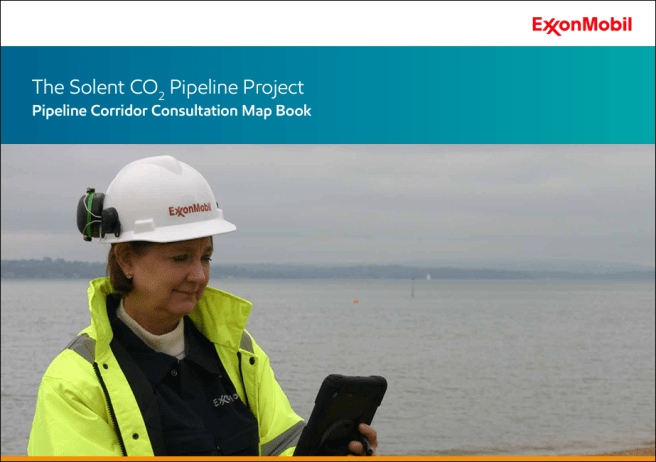
For further detail of the three shortlisted routes, refer to the ‘book of maps’ by clicking the first image below. For details of the routes which were not selected, please click the second image below.

Solent Protection Society is surprised to note that the direct undersea routes, from Fawley to the east of the Isle of Wight or to the west directly out through Hurst Narrows, have both been dismissed. On the face of it, this seems a perverse and questionable decision. Why would the company propose a route that crosses extensive amounts of private land, when an end-to-end underwater route is feasible, from the Fawley waterside to the saline aquifer storage rocks offshore to the southwest of the Needles?
A significant flaw in the consultation is the absence of any detail relating to the approach proposed for construction onward from the Solent to the saline aquifer. Will it be bored, put in a shallow dug trench or simply rested on the seabed? We suspect the latter, but will be asking the question in our response.
Where can I find the detail?
Click on the download link below to open the ExxonMobil corridor consultation brochure which contains the important details.

Detail and images within this post have been sourced from the ExxonMobil Consultation Website, to which link we would refer you for additional detail relating to the consultation.
What are the timescales?
The formal process leading to the application to the Secretary of State for a Development Control Order will take place over a number of sequential phases, indicated in the following timeline:

If approved, the construction programme would take at least a further two years before an extended period of land recovery could be managed.
How can I engage with this consultation?
The damage to the ecology and habitats in these (mostly) protected areas would be significant and long lasting, a concern that needs much further investigation. Farmers and landowners will be particularly concerned and we would urge all who live in the areas affected to attend one of the consultation events scheduled to run between 6 August and 16 September. The venues and dates are shown below:
| Macdonald Elmers Court Hotel & Resort, Lymington, Hampshire, 16 August |
| Shalfleet Village Hall, Newport, Isle of Wight, 22 August |
| Phoenix Knights Centre, Cowes, Isle of Wight, 23 August and 3 September |
| Niton Village Hall, Ventnor, Isle of Wight, 24 August |
| The Bridge Community Centre, Milford on Sea, Hampshire, 30 August |
| Calshot Activity Centre, Calshot, Hampshire, 4 September |
| Jubilee Hall, Fawley, Hampshire, 5 September |
The BBC report from the first two consultations can be read by clicking the image below:

How can I respond to this consultation?
Editor’s note: Before you respond, it may be worth reviewing other update posts from SPS: For the full set, follow this link to the overview: solentprotection.org/exxon
When you’re ready to submit your response to the consultation, you have three options.
The first option, which we do not recommend, is to use the online form provided by ExxonMobil which you can find by taking this link.
Note, however, that the pre-formatted questions give no opportunity to question the direction being taken or dispute the three pipeline corridors shortlisted. The exercise simply asks the respondent to rank the three selected corridors in order of preference. It is difficult to see how anything other than an arbitrary ‘Isle of Wight vs New Forest’ ranking could be derived from such trivial questions.
The second option, which we would recommend, is to set out your own documentary response including as much detail as you see fit, either as text in an email, or in a document attached to an email.
The email address for responses is info@solentco2pipeline.co.uk, and we would suggest a subject line of “Solent CO2 Pipeline Consultation response”. As an aid, if you click this text, your email program should open, pre-set with the email address and subject.
You may also wish to consider copying the email response to your Member of Parliament, whose email address you can find at this link.
The third option is to write your response on paper, and post it to the consultation team at this address:
Solent CO2
Pipeline Project, 1180 Eskdale Road, Winnersh,
Wokingham, RG41 5TU
UK
Please ensure that your responses are completed and returned by 6pm on the closing date – Monday 30 September
The increasing use of Development Control Orders
ExxonMobil have declared this to be a Nationally Significant Infrastructure Project (NSIP). These are major infrastructure development projects for which the applicant can apply directly to the relevant Secretary of State for a ‘Development Control Order’, bypassing local planning authority procedures in England and Wales. The Secretary of State will rely on the guidance of a Planning Inspector appointed by the Planning Inspectorate. (Note: The NSIP Wikipeda reference provides some useful commentary on the NSIP public consultation procedure.)
The Planning Act 2008 means that a Development Consent Order is only needed to cover the section of pipeline that is onshore or in inland waters, which includes bays and any crossing of the Solent, if required.
The marine section of the pipeline is not part of the Nationally Significant Infrastructure Project, but is separately consented under a ‘Pipeline Works Authorisation’ from the North Sea Transition Authority, NSTA, an executive non-departmental public body sponsored by the Department for Energy Security and Net Zero. Similarly, the CO₂ storage project is not part of this consultation and is separately consented, once again by the North Sea Transition Authority.
Whether a remotely appointed Planning Inspector, the Secretary of State or the North Sea Transition Authority has any understanding of the concerns of the local Solent residents and businesses is a moot point.
The public ‘consultation’ opportunities for Nationally Significant Infrastructure Projects appear simply to be opportunities for developers to broadcast marketing material to the local community while counting the number of that community who attend and comment.
In effect, these consultations are little more than opportunities to tick necessary boxes to meet key milestones in the design and development programme plan.
These NSIP ‘Development Control Order’ planning applications are viewed with some concern by Solent Protection Society, given the lack of weight accorded to local authority planning expertise and existing environmental designations. The Society has similar concerns over the proposed relaxation of planning regulations within the Solent Freeport tax and customs sites, where local authority concerns and environmental designations can be overturned by a higher level ‘virtual’ planning authority.
The Solent CO2 Pipeline Project is comparable to the Aquind Interconnector project, a contentious project in the eastern Solent which is still in some doubt following concerted objections by affected residents, Portsmouth City Council, Havant Borough Council, a cross-party grouping of MPs and now the Ministry of Defence. Originally refused by the Secretary of State, the Aquind development consortium overturned that original decision on appeal in the High Court.
More recently, Solent Protection Society responded to another locally contentious NSIP consultation over a proposal by Southern Water to construct an advanced Water Recycling Plant on a sensitive waste landfill site adjoining Langstone Harbour.
This is the first SPS post on the subject of the ExxonMobil ‘Solent CO2 Pipeline Project.
The full list of SPS Posts on the subject can be found by clicking this link.
To read the next in the series, click here.
 Solent Protection Society