I wrote an article for our 2024/2025 newsletter about the two FCERM (Flood and Coastal Erosion Management) Coastal strategies in the Western Solent. Since publication, the Draft Adaption Pathways have been released to the public and public exhibitions held to explain them to the public, see the further reading section below for detail.
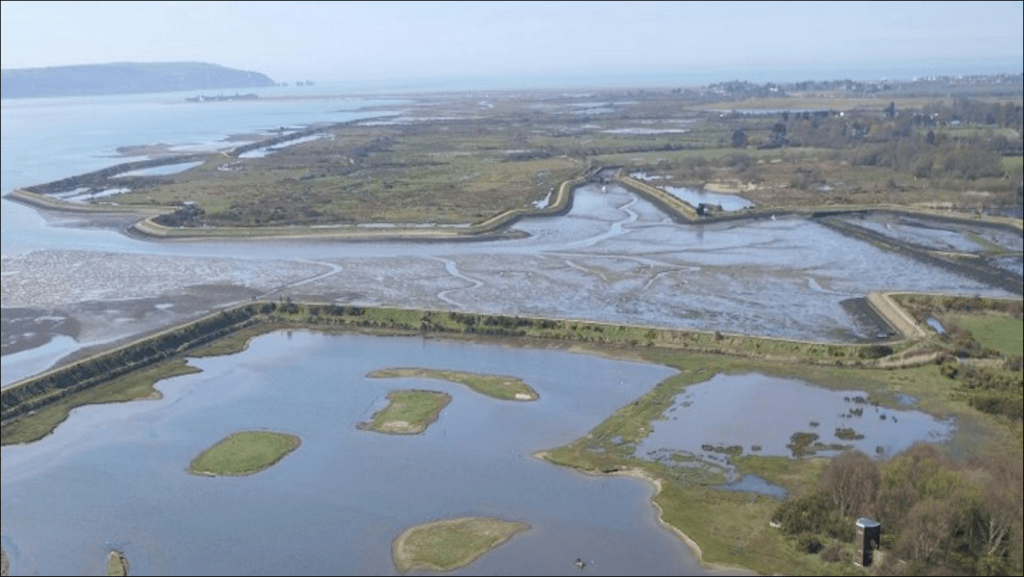
There has been a reaction to these pathways from some of the public and press, and so I hope this article will help our members understand both the purpose and the implication of the strategic options that are put forward by the strategy. Both the Draft Pathways and the project team’s response are available on their website, which you can open in a separate browser window by clicking the image below:
Context
Coastal Strategies are part of a national process of FCERM management to enable long-term strategic decisions on the coast of England and Wales. They have two main purposes:
- To take forward the Strategic Options set out in the Shoreline Management Plans (SMP’s) and produce more detailed options for smaller lengths of coastline, these options need to be practical – i.e. they need to be economically justified and legally compliant.
- To enable the Environment Agency (EA) to assess the total need for FCERM expenditure across the country. This in turn will help the EA justify to Defra and the Treasury the long-term finance required for sustainable coastal management for the whole country in the future.
In the past FCERM projects were generally designed to be built “now” and last for the life of the structure – 60 to 100 years. So there have been several projects built before the current knowledge of Climate change, hence sea-level rise, which now need to be re-thought before the end of their design life.
Current thinking is that the true extent of sea-level rise over the next 100 years is very difficult to estimate, it will depend on Worldwide Politics. So, a much better choice is “Adaptive Management” where decisions are made now for the next 25-50 years, but allow future generations to adapt when they have greater knowledge. Or to put it simply a “No Regrets” policy, that avoids future generations being confined by our current decisions.
The “Draft Adaption Pathways” that have recently been published, are an example of Adaptive Management, are not definite projects, these will be developed over the timescales indicated, often 10-20 years. It is at this stage that details, like the exact location of new defences, will be determined.
Legislation
People often ask whether anyone has “responsibility” to maintain or even improve sea defences. The short answer is “Nobody in responsible”. Both the EA and the “Maritime District Council” (In this case NFDC) have discretionary powers to construct and maintain flood defences and the Maritime District Council has powers, under separate legislation, to construct and maintain coastal defences to manage control erosion. Both these agencies will generally only exercise these powers where there is funding available, and this is ultimately from the Treasury. They obviously will only do anything that is legally compliant, and this includes the current environmental legislation.
People and the Environment
In the past there has been a tendency for people to think that we need to either protect people or the environment. In Victorian times Engineers talked about taming or controlling nature, however most people now realise it is much better to work with nature rather than against it. For instance, locally it is now recognised that encouraging salt-march development on the seaward side of a seawall will not only improve the environment but also break waves and so reduce exposure, hence the cost of maintaining the seawall. In some cases, it may be necessary to move the seawall to a position where salt marshes will develop, rather than be eroded.
Morphology of Hurst Spit
Spits are natural dynamic structures that form where there is an abrupt change in direction of the coastline. Although they are often “dynamically stable”, they are always moving and rely on a steady supply of new material. For various geological and other reasons, the supply of shingle to Hurst Spit has reduced over time and it is now also supported by import of material.
If the spit were entirely natural, i.e. there was no castle on the end, it would have moved North from its current position and remained dynamically stable. This happens by overwashing in storm events when shingle is stripped from the seaward face of the spit and deposited on the landward side.
If maintenance is reduced in future, the spit will adapt to the new circumstances, it will try to move North and there may well be several overwashing events before it reestablishes a new dynamic equilibrium. It is highly unlikely that the spit will “breach” or disappear, so its value of reducing wave action between Keyhaven and Lymington will remain.
The draft pathway for the spit, shown in the exhibition, suggest maintenance for 10-20 years and then a reduction, when other projects have been done. There is no proposal to “breach” the spit, and so if this pathway is followed the form of the spit will change, but it will remain a barrier to waves entering the Western Solent for many years ahead. It has probably existed in roughly its current form for at least 10,000 years (Since the chalk ridge from the Needles to Old Harry was breached) and so will remain for many years to come.
Silting of the Lymington River estuary is largely determined by the “Tidal Prism” (The amount of water that goes in and out of the estuary on each tide) and so is unlikely to be significantly changed by different management of the Spit.
Future Consultation
The timeline for the strategy is shown right at the bottom of the Strategy Overview on the project website, however I have copied it here:
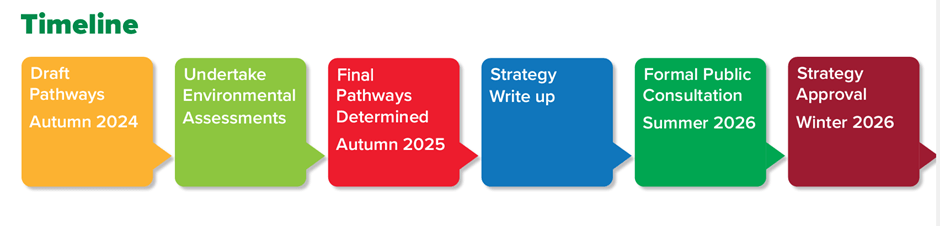
So you will see that, although the final Pathways will be available this autumn, there will be another round of formal consultation in the Summer of 2026. This is followed by formal approval of the Strategy in the Winter of 2026. This process allows for input from both the public and elected politicians.
Even after this there will be further detailed local consultation on projects that emanate from the Strategy.
Although the process seems very long-winded, approval of the Strategy, will shorten the timescale for approval of finance for projects that come from the Strategy.
Conclusion
I have been the SPS representative on the Stakeholder Advisory group (StAG), which includes all interested parties, since the beginning of the Strategy development and so hope this update is helpful. I will try to keep our members updated through the website and future newsletters. But if you have any concerns please get in touch either through the website, or to any Council member.
Tim Kermode MA CEng MICE CIWEM
Coastal Engineer and member of the SPS Council
Further Reading
Draft Adaptation Pathways (2024)
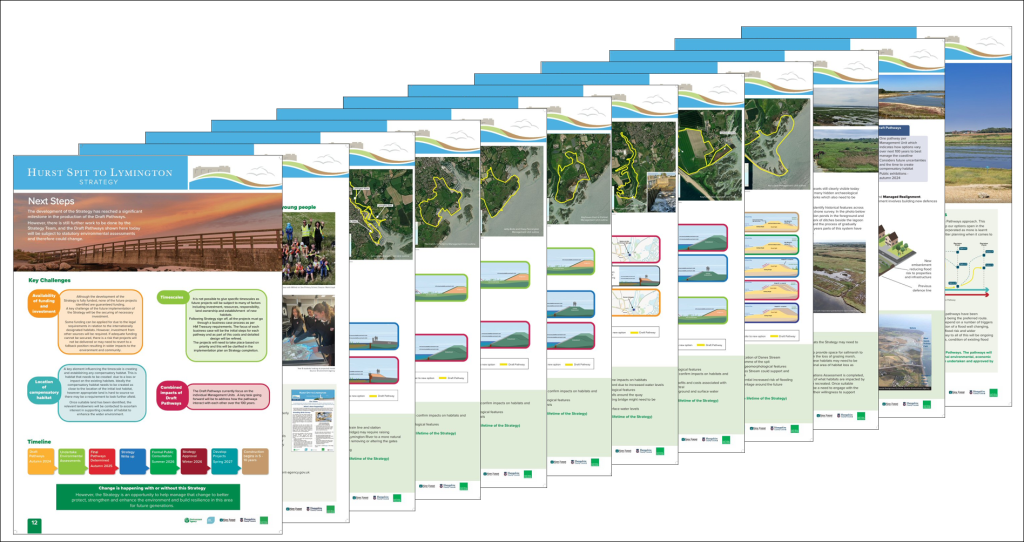
The public information boards explaining the Draft Adaption Pathways for the Hurst Spit to Lymington project can be viewed by clicking the image below. The detail will be presented as a large PDF file in a separate browser window, showing the detailed printed information from all twelve boards. Depending on your speed of connection, this may take a short time to load.
Environment Agency video (2022)
The following video was produced by the project team three years ago but still provides a useful introduction to the objectives of the Hurst Spit to Lymington project.
Previous articles on Shoreline Management
To read previous SPS articles on Shoreline Management, please take this link.
 Solent Protection Society