Southern Water has published the latest version of its Water Resources Management Plan (WRMP) to solicit feedback from the public on the company’s proposed options for future water supply. This new plan, spanning 32 volumes of extensive and often repetitive documents, heavily promotes the marketing message that “the answer is Water Recycling”.
Unfortunately, the WRMP lacks even a basic assessment of more cost-effective and environmentally-sustainable alternatives, which would have provided balance and enabled a more objective evaluation.
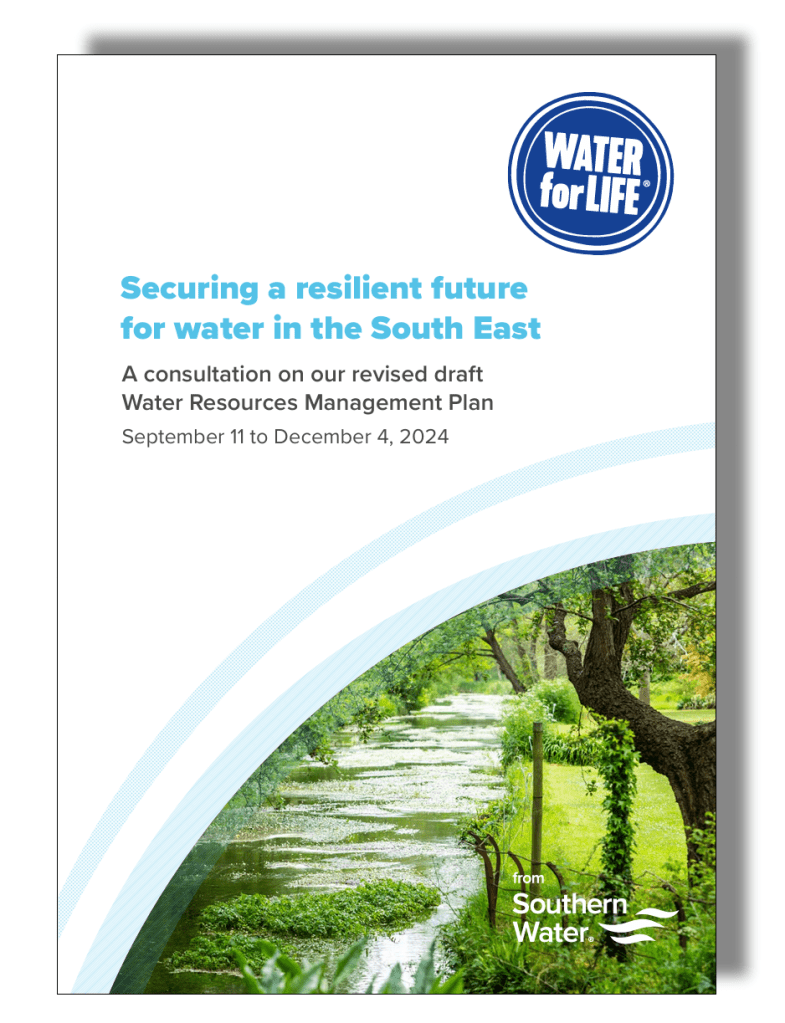
The Water Resources Management Plan sets out Southern Water’s selected options for future water supply. These dismiss more environmentally-sound and sustainable ‘nature-based’ options in favour of costly, energy-intensive reverse osmosis (RO) filtering for sewage treatment effluent recycling as an extension to existing wastewater treatment works (WWTW). Three sites are proposed in and around the Solent region at the Budds Farm WWTW at Havant in Hampshire, the Sandown WWTW on the Isle of Wight and the Littlehampton (Ford) WWTW to the east, near Arundel in West Sussex.
The WRMP notes that each plant would discharge roughly 75% of the final filtered effluent into an ‘environmental buffer’, either directly into a river for downstream re-abstraction in diluted form or, in the case of Budds Farm, by pumping the output via new pipelines to be buried beneath the streets of Havant into Portsmouth Water’s new Havant Thicket Reservoir, for mixing with the pure Bedhampton chalk spring water that the reservoir was originally designed and approved to hold.
The remaining 25% of the final filtered effluent would be discharged into the maritime environment as a reject stream of hot, concentrated brine waste via the existing long sea outfalls at Eastney, Sandown and Littlehampton. It’s worth noting that these new wastewater treatment site extensions would not offer any improvement to the current unacceptable levels of discharges from Southern Water combined sewer overflows (CSO).
BBC South Today, Monday 4 November
On Monday 4 November 2024, BBC South Today announced that the Sandown water recycling plant would be the first to be delivered in the Southern Water plans, but failed to mention the Company’s ongoing WRMP consultation.
The programme content, entitled ‘Toilet to Tap’, took just three minutes to cover the high-level picture as Southern Water would like it to be told. The reality is rather different, as we explore in a breakdown of the report following the video clip below.
That three minute piece makes a large number of points within its limited timeframe, so we break down the clip into 7 segments to add commentary on some of the significant points overlooked. In each case, you can click on the link provided to skip to that part of the report.
Segment 1 – Click link to view – The introduction to the report
The report begins with a snappy headline ‘Tap to Toilet’, which grabs the attention and sets the scene for the ‘Yuck factor’ segment further down. The scheme is introduced as ‘a £100m plus proposal’, a figure that experience with the continually escalating costs of the Company’s proposed £1.2bn ‘Hampshire Water Transfer and Water Recycling proposal (HWTWRP)’ for Budds Farm WWTW in Havant suggests might be significantly under-called.
Segment 2 – Click link to view – Southern Water’s high level picture of sewage treatment effluent recycling
This segment follows a description of the process in which the reporter pitches the Southern Water marketing message using the Company’s graphics.
Segment 3 – Click link to view – Southern Water’s ‘Director of Water’
Tim McMahon, Southern Water’s ‘Director of Water’, follows-up the marketing message with a sales pitch for the Company’s “very sophisticated technology” proposal for Sandown, summarising how the “sewage treatment effluent” would be handled by the high-tech RO ‘Water Recycling’ process. It was interesting to hear Tim refer to the process as “Sewage Treatment Effluent Recycling”, rather using the Company’s preferred marketing euphemism of ‘Water Recycling’.
What is also not made clear is that recycled sewage treatment effluent is not primarily used for drinking water purposes in the countries which currently practice it. Currently, the state-owned Water Corporation company in Western Australia does not directly provide recycled water for drinking via domestic taps. Instead, it recycles wastewater primarily for non-drinking uses such as irrigating public spaces and industrial applications, as well as supporting environmental projects such as wetland habitats.
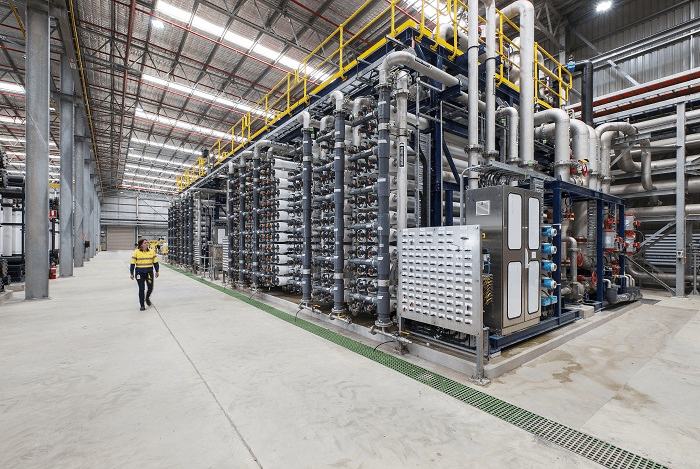
Across Western Australia, about 75% of wastewater is recycled, with significant portions used for irrigating crops, industrial uses, and environmental conservation projects rather than as drinking water (potable use). The majority of recycled water in urban areas is specifically dedicated to non-domestic purposes, ensuring a sustainable water cycle adapted to local climate needs without directly mixing recycled water with the potable supply pipeline.
Segment 5 – Click Link – The plans will go out to public consultation
This statement implies that the Sandown plans will go out for consultation ‘at some point in the future’. The equivalent effluent recycling project at Budds Farm in Havant has already been pre-registered as an NSIP and while SPS were told at the Newport consultation event on 6 November that the Sandown project would be submitted for local authority planning approval, it seems likely that Southern Water will take the opportunity of seeking a ‘Section 35 Direction’ from the Secretary of State to declare this a Nationally Significant Infrastructure Project, NSIP, effectively bypassing local public consultation. The equivalent proposal at Budds Farm in Havant, originally proposed for local authority planning process, has already been redesignated and registered as ‘an application for a Development Consent Order (DCO)’.
Segment 6 – Click link – The Yuck Factor
The popular arguments for and against effluent recycling are encapsulated in these four carefully selected cameos from interviews in a Cowes’ street. The last, in particular, sets up discussion of the ‘Yuck Factor’ which will certainly need much greater marketing spin to reassure the wider public. The report which follows notes the need to sanitise the sales message by removing any trace of the word sewage, in Singapore even calling the output ‘New Water‘. What it doesn’t point out is that in a comparable western situation, in California, the public reaction to an effluent recycling project resulted in a significant increase in the sales of bottled water.
Segment 7 – Click link – This could be one of four new such schemes
This piece of the report curiously links the Sandown effluent recycling proposal with Portsmouth Water’s Havant Thicket Reservoir. The link between the Sandown proposal and the Havant Thicket Reservoir is, at best, extremely tenuous. By succeeding in registering the much simpler Sandown water recycling scheme as a NSIP, Southern Water might expect to set a precedent with the Planning Inspectorate and with DEFRA.
Solent Protection Society registered an objection to the attempted hijacking of the under-construction Havant Thicket raw-water reservoir in a post introducing the Society’s response to Southern Water’s previous consultation on its Hampshire Water Transfer and Water Recycling Project in July 2024.
Water recycling plants in the UK were not automatically classified as “nationally significant infrastructure projects” (NSIPs) under the Planning Act 2008, which governs large infrastructure projects like highways and energy plants. However, they can achieve this designation on a case-by-case basis if the Secretary of State deems them critical to national water resilience or drought protection through what is termed a “Section 35 direction”. If Southern Water succeed in getting these ‘effluent recycling projects’ designated as NSIPs, they will be determined at a national level rather than through local planning authorities, thereby avoiding local engagement, scrutiny and debate.
By succeeding in getting the Sandown effluent recycling plant registered as an NSIP, the company would not only set a precedent for other proposed effluent recycling projects, but would also set a precedent for construction of such a development on a former landfill and in a flood plain, a factor which would be to the Company’s advantage with its plans for Budds Farm.
In summary
It is very disappointing to note that at no point in this report did Southern Water or the BBC refer its audience to the current Water Resources Management Plan consultation, which ends on 4 December.
Publicity for Southern Water public consultations is kept to the bare minimum required by the regulators. Instead of using its regular billing process to invite its customers to consultations on its future plans, the Company leaves residents to seek out and find the fine-print announcements of these consultations buried within the back pages of the local print media or summarised deep down in its online website.
This current consultation is that last opportunity that members of the general public will have to express their views on adding RO effluent recycling to drinking water supply to DEFRA. There will be many members of the public, customers of the local water companies, who would prefer that greater focus was placed in the WRMP on proven, low risk, nature-based options such as managed aquifer recharge and the construction of a network of winter-storage reservoirs.
Solent Protection Society believes that the general public has a right to understand the Company’s justification for the rising costs of the bills that they will be receiving and look to our members and readers to take the time to respond. Full details are provided at the end of this post.
The report fails to address the weakness of Southern Water’s current Options Appraisal. The readily available, lower cost, sustainable and environmentally-sound options for securing a future drought supply are excluded from the current selection of options and little evidence can be found of them within the 32 volumes of consultation material made available to the public.
Further reading and guidance on how to respond to the Consultation
The Sandown project which was the subject of the BBC report is not the first of Southern Water’s forays into effluent recycling. For the past two years, concerned residents and local councillors in the Havant area have been fighting Southern Water’s attempts to hijack Portsmouth Water’s Havant Thicket Reservoir for use as an environmental buffer lake for the larger effluent recycling plant proposed for Budds Farm sewage works.
The Havant Matters website provides the single most accessible and informed point of contact for the detail relating to the current Southern Water ‘Water Resource Management Plan’, including direct links to the 32 volumes of publicly available Southern Water consultation material and easy instructions for responding to DEFRA, with copies to the Southern Water team.

We refer you in particular to the following pages:
A Better Way Forward – Click here to read
and
Southern Water’s WRMP – 40 Key Concerns – Click here to read
 Solent Protection Society