
By the time the ExxonMobil consultation had closed on 30 September, a significant number of respondents were following Solent Protection Society’s lead in proposing to highlight concerns directly to the Planning Inspectorate and the Department of Energy Security and Net Zero. Three days later, on 3 October, ExxonMobil announced that it had “decided not to progress with the CO2 storage in the English Channel, and as a result, the Solent CO2 pipeline project will not proceed.”
What happened next
While the environmental protestors and the social media keyboard warriors were quick to claim the victory and the local press and media expressed surprise at the ‘unexpected’ speed of the decision, the real reasons had actually been predicted in the SPS website reporting. The pipeline project could not stand up as an NSIP in its own right, the proposed storage site was not licenced and the carbon capture project at Fawley was but a dream.
The very same day, the Department of Energy Security and Net Zero reported its commitment to £22bn funding to the East Coast and North West industrial clusters to continue their carbon capture and storage projects. While that decision had been quite predictable and would have already been known to ExxonMobil, the company expressed public surprise and disappointment in the Government’s announcement, stating that “Despite our efforts over the past three years to secure the necessary government policies and market conditions to support the significant investment required, we have concluded that these conditions are not currently in place.”
The ‘Solent CO2 Pipeline’ project was hastily dropped, doubtless to save any further expense from an ill-timed and poorly thought-out consultation. It may just have served its purpose though, since the more cynical observers noted that the company could now claim that it was the strength of public opinion that had forced it to abandon its decarbonisation plan for Fawley.
How serious a consultation was this?
Just how seriously ExxonMobil took its role in the Solent Cluster is worth questioning. Two days after the proposal was dropped, SPS received a response to an earlier Freedom of Information request seeking to understand the extent of ExxonMobil’s financial investment in its research partner for decarbonisation, Southampton University. We were a little surprised to find that there had been none.
It is also worth questioning how seriously the Solent Cluster is taking its role. In January, it received an award of £757,601 from a bid to the UK Government’s Local Industrial Decarbonisation Plan fund. Looking at the organisation’s 2024-25 business plan, that should sustain its staffing, marketing and expenses for a couple of years. Apart from £100,000 worth of unspecified ‘consulting’, there appears little of substance in the budget.
Just as DP World’s departure deflated the Solent LEP’s Freeport balloon, is it possible that ExxonMobil’s ‘Solent CO2 Pipeline’ consultation was only ever intended to burst the Solent Cluster’s bubble and kick decarbonisation of the ageing refinery into the long grass as something ‘too hard to do given the public opposition’?
What now for the future?
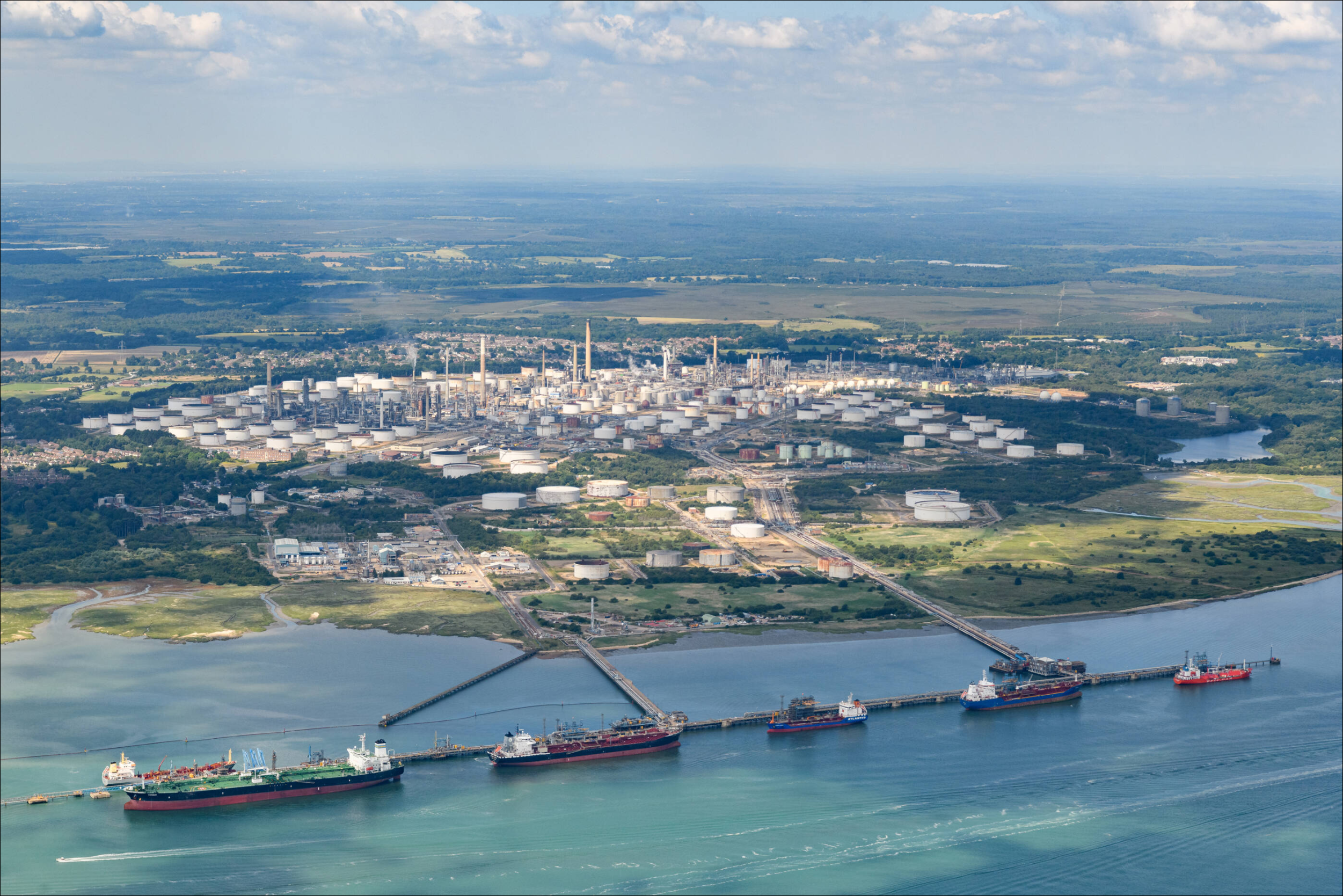
The problem of what to do about Esso Fawley has not gone away. Following this deliberately provocative consultation, it doesn’t look as if ExxonMobil has any intention to make any significant investment at the site.
In the long term, it seems likely that the Fawley refinery site will follow Grangemouth’s example, dropping traditional oil refinery functions in favour of extended import facilities for refined carbon-based products from elsewhere in the world. The potential remains for a future biofuel refinery operation and potentially for then generation of green hydrogen. That, however, will require a level of investment that will need external partners with deep pockets, following the lead taken by Ineos with PetroChina at Grangemouth.
As the Government’s net zero strategies evolve, carbon capture and storage and the generation of blue hydrogen from imported liquefied natural gas are unlikely to remain the answer. With extreme weather events becoming more frequent and getting closer to home, communities across the UK will need to wake up to the fact that they need to consume less energy and demand renewable sources for that energy.
To read the full set of SPS posts on the 2024 ExxonMobil CO2 Pipeline proposal and consultation, click the image below.
 Solent Protection Society